Willenwood Grove

Tag: upcycle

  • My DIY Moss Rug Bath Mat

    My DIY Moss Rug Bath Mat

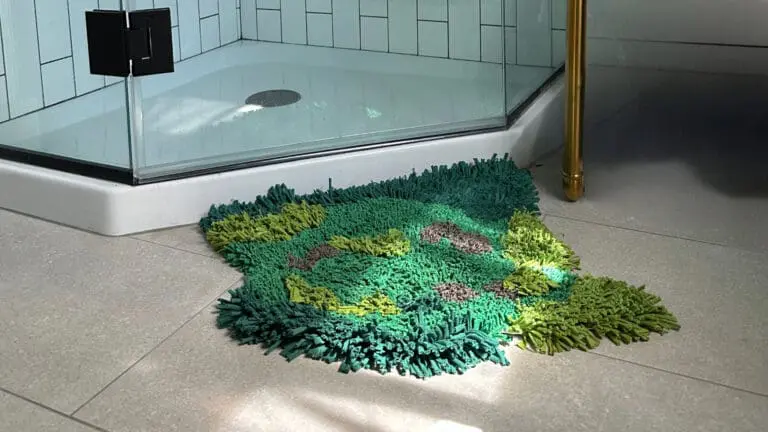
    After watching this video, I really wanted a moss rug. Not a rug made out of real moss, a rug made out of regular rug materials that looked like a soft bed of moss. The rug in this video is quite large, but I had neither the space nor the patience for an undertaking of that magnitude. I opted for something smaller, knowing that the one place I actually needed a rug at the moment was the bathroom. Tired of stepping out of the shower onto the tile and immediately dripping a puddle all over the floor, I set out to craft a little moss rug bath mat.

    Now, the bathroom that this rug was going to be in is very small. The shower is a stall not a tub, and it is tiny. I didn’t want the rug taking up the whole floor, so I made it quite small (although maybe too small). Anyway, it looks super fun and it dries my feet, and that’s all I ask for.

    I’ve been on a ‘don’t buy stuff’ kick lately, because I have so much stuff, especially craft supplies, and I do not want to have to organize any more stuff. With this in mind, I wanted to make the rug out of things I already had in my house. I only half succeeded because I did buy a latch hook and mat, but for the actual moss on the rug, I used cut up T-shirts and some cotton yarn I already had.

    DIY Moss Rug Bath Mat

    Preparing for the project

    I decided to make this moss rug bath mat, and sketched a few ideas for it. I did some Googling to figure out the easiest way to make a rug and landed on the good old latch hook method, which I definitely did as a kid, though I don’t remember what I made.

    Having no latch hook supplies, I did order a small mat and a hook off of Amazon. You can find the mats pretty affordably in a variety of sizes (and the same for the hooks, actually).

    I laid out the mat, and outlined some basic areas for different types of ‘moss’ with a marker. Then I decided I didn’t like that pattern and outlined some different areas.

    Now, I needed a lot of material to actually do the latch hook. Since this is a bath mat, I wanted something absorbent but fast drying. I did some more Googling, and landed on cotton as my fabric of choice. This was perfect as I had a bunch of old cotton T-shirts! I took the one green T-shirt I had and cut it up into strips to try it out. This worked great (you can find info on making your own T-shirt yarn at fiberartsy.com). I got to work hooking, and thought it was looking pretty good.

    We need more yarn

    But I had nowhere near enough yarn for the entire rug. This was fine, as I didn’t want the whole mat to be one color anyway, but it meant I had to dye a bunch of white T-shirts various shades of green.

    At first I tried using food coloring, as some sources said this would work on cotton. However, after I tried it, I found other sources confirming that it does not work at all. Cotton won’t absorb much if any of the food dye, and you just come out with the palest ghost of the color you wanted. So I bought some actual fabric dye.

    I cut up the T-shirts before dying them, I don’t really remember why, threw them in a pot with the dye, followed the dye directions, etc, etc, and ended up with some nice T-shirt yarn in a few lighter shades of green. After letting the yarn dry, I was ready to get back to latch hooking.

    This took a while, but was pretty much just your average latch hooking experience. I found it helpful to hook strands of yarn around the outside of each section first, so I didn’t accidentally add more yarn in that color than I wanted to. 

    As I went along, I decided I didn’t want the rug to be just shades of green. I added in a little brown with some cotton yarn I already had. The yarn was thinner than the T-shirt yarn, so I doubled it up on itself.

    Finishing it up

    Tennessee helped a lot. I almost made a ghillie suit instead.

    When I was finished, I cut out around the edge of the rug, leaving a few inches of empty mat. I folded these edges under the bottom of the rug, and sewed them down with my cotton yarn. I cut out a piece of anti-slip rug mat and put that underneath to avoid the mat sliding. (This wasn’t attached, the rug just sits on top of it)

    And done! I think it looks nice, and it works great. No more puddles on the bathroom floor, and the fabric dries quickly. When I step out of the shower, I can imagine I’m a of forest creature stepping from beneath a waterfall onto the mossy forest floor. Magical.

  • DIY Planter from a Protein Powder Container

    DIY Planter from a Protein Powder Container

    If you have a lot of big containers, or even small containers, you can turn them into planters. This will save you money and avoid more plastic going into the recycling bin. In this article will show you how to make a totally self contained DIY planter, with an integrated drip tray, out of a protein powder container.

    All you will need is a container and an Exacto knife. You might also want a piece of paper, tape, and a drill with a big drill bit in it. This is a great DIY craft for large plastic containers you have left over.

    Here’s how to make a DIY planter.

    DIY a Planter

    Materials and Tools

    • Large plastic container with a lid
    • Exacto knife
    • Paper
    • Tape
    • Drill with large drill bit (optional)

    Cut off the top of the container

    Wrap a sheet of paper around the container to get a straight edge for cutting off the top. Tape the paper in place so it doesn’t slide away.

    Then, cut the top off with the Exacto knife following the edge of the paper. Make sure to keep the top you cut off!

    Trim the cut top

    Trim off a half inch to an inch of the top of the container. You’ll use this to ensure the lid doesn’t hit the bottom of the container (which would allow water to seep back up into the soil). It will also help keep the top from ending up at an angle since it will have something to rest on. 

    Cut the trimmed plastic in half and make a circle out of part of it that is a little smaller than the cap.

    Make some holes

    Drill (or cut) some holes in the cover of the container to act as drainage. You can also make a hole in the back of the container just under where the top will sit when inside. This will let you dump out any water that collects in the bottom of the pot.

    Assemble

    Place the small circle of plastic in the bottom of the pot. Push the top of the container down into the bottom of the pot, with the lid on the bottom.

    A drawing of the cross section of the pot

    That’s it! Now you can fill the planter with soil. Excess water will drip into the very bottom of the container, and either evaporate out the hole in the back or it can be dumped out. The bottom of the soil is kept out of the excess water so your plant won’t become waterlogged.

    Plant

    Add some soil and a plant, and enjoy your new planter!


    Close up of an angel wing begonia leaf

    Wondering what to plant?

    Browse our favorite colorful, easy-to-care-for houseplants


    Bonus Planter Ideas

    If you have a container with a lid and the top of the container is wider than the bottom, just take the lid off and use it as a drip tray. Drill a few holes in the bottom of the container and you have a new planter. You can also use plastic lids as drip trays for other unique container planters.

    In Conclusion

    If you’re wondering ‘what can I do with protein powder containers?’ or ‘crafts with plastic containers’ or even ‘DIY plant pot’, hopefully this article shows up for your search query and you can get some ideas for making your own DIY planter. 

    Thanks for reading! Happy planting!

  • DIY Cardboard Box Patterns

    DIY Cardboard Box Patterns

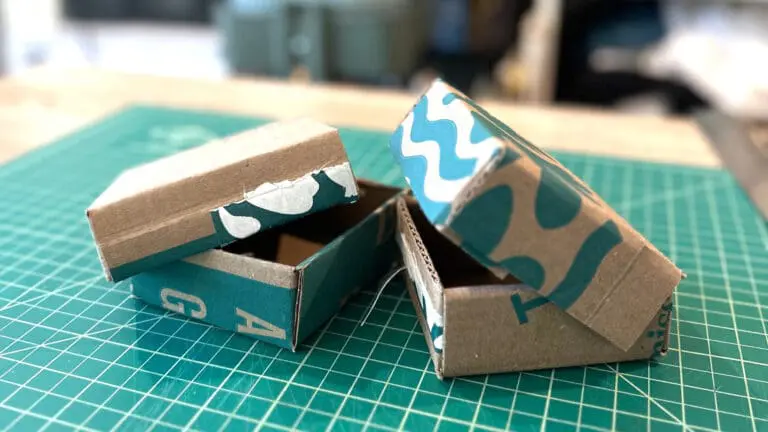
    Do you need a box? A box that is a specific size? Do you have cardboard but no box but need a box? Well, guess what: We can show you how to make a DIY box in whatever size you need with whatever pieces of cardboard you have laying around.

    DIY Cardboard Box Patterns

    We have several box patterns for you – a clamshell box and a box with a removable lid. I have devised formulas that will tell you the size of the flat rectangle you’ll need to make a box of the size of your choosing. 

    Here are the formulas:

    A = width
    B = length
    C = depth

    Choose the size of the box you’d like and assign the appropriate letter to that value.

    For a clamshell-style box, cut out a piece of cardboard that is this size:

    Width = (A*2) + (C*3)
    Length = B + (C*4)

    For a box with a removable lid, cut out 2 pieces of cardboard that are this size:

    Width = A + (C*2)
    Length = B + (C*4)

    Next, we’ll see how to assemble the whole box.

    How to make a clamshell box

    Materials & Tools

    • Cardboard
    • Scissors
    • Exacto Knife
    • Ruler
    • Pen
    • Craft Glue

    Choose your box size and calculate


    Choose the width, length, and depth of your box. Assign the appropriate value to each letter.

    I’m making a 5in x 5in x 1.5in box, so I will assign A = 5, B = 5, C = 1.5.

    A = width
    B = length
    C = depth

    Calculate the size of the cardboard you’ll need using:

    Width = (A*2) + (C*3)
    Length = B + (C*4)

    For my 5in x 5in box, this comes out to 12.5in x 10in.

    Cut out a cardboard rectangle with your calculated width and length.

    Optional: Cut out a square of cardboard that C x C. This is very useful later on for marking cutting and folding lines for this DIY box.

    Mark and cut out the corners

    Trace a C x C square onto the bottom corners of the cardboard rectangle, two sides of a C x C square onto the exact middle of the edge of the long side of the cardboard, and one side of the square in the top corners. See the first photo for what your marks should look like.

    Connect the squares from the middle and top corners (photo 2). Cut out areas that you just traced (photo 3)

    Mark scoring lines for the bottom of the box

    Mark the lines where the bottom of the box will be cut and scored for folds. Use solid lines to cut and dashed lines to score, using the pattern in the last picture.

    Mark scoring lines for the top of the box

    Mark squares in the top corners of the cardboard that have the dimensions of (C – 1/4). You can cut out a small piece of cardboard this size to trace around. These measurements will make the top of the box a little wider than the bottom, allowing the lid to close. Mark cut (solid) and score (dashed) lines as shown in the photos.

    Score and cut the box

    Score along the dotted lines and cut along the solid lines

    You can now fold up the bottom of the box and make sure everything is working as expected.

    Trim and adjust

    If it’s difficult to fold, cut out a little on the sides of the flaps to make extra room for the folds.

    Fold the box and secure

    Glue (or staple) the small flaps on the front and back sides to the inside of the left and right sides, to keep the box together. For easier folding, fold with the scoring on the outside. Get a smoother look by folding with the scoring to the inside of the folds.

    I found that hot glue does not work very well to keep the box together, so I used craft glue and held the box together with binder clips while the glue dried.

    Tip: If the lid of your box doesn’t stay closed, try scoring the other side of the fold on the back of the box as well. Pinch the fold together to open up the new scored line and help the lid stay shut.

    Use your new box

    Now you have a great new box for whatever you needed a box for! Maybe a gift?


    DIY an Elegant Gift Box

    Elevate and enhance your giving with a custom gift box


    How to make a box with a removable lid

    Materials & Tools

    • Cardboard
    • Scissors
    • Exacto Knife
    • Ruler
    • Pen
    • Craft Glue

    Choose your box size and calculate


    Choose the width, length, and depth of your box. Assign the appropriate value to each letter.

    A = width
    B = length
    C = depth

    Calculate the size of the cardboard you’ll need using:

    Width = A + (C*2)
    Length = B + (C*4)

    Cut out 2 cardboard rectangles with this width and length.

    Optional: Cut out a square of cardboard that C x C. This is very useful later on for marking your cutting and folding lines.

    Cut out the corners on the bottom

    Trace a C x C square onto each corner of the cardboard rectangle.

    Cut out the corner squares that you just marked.

    Score and cut the bottom of the box

    Mark lines as shown in the photos, and cut solid lines and score along dotted lines.

    You can now fold up the bottom of the box and make sure everything is working as expected.

    Score and cut the top of the box

    Mark smaller squares in the corners of the other pieces of cardboard that have the dimensions of (C – 1/4″). You can cut out a small piece of cardboard this size to trace around. These measurements will make the top of the box a little wider than the bottom, allowing the lid to fit on. Mark cut (solid) and score (dashed) lines as shown in the photos.

    Trim and adjust

    Try folding up the box and lid. If it’s difficult to fold, cut out a little on the sides of the flaps to make extra room for the folds.

    Fold the box and secure

    On both top and bottom, glue (or staple) the small flaps on the front and back sides to the inside of the left and right sides, to keep the box together. For easier folding, fold with the scoring on the outside. Get a smoother look by folding with the scoring to the inside of the folds.

    Use your new box

    Alright! Put some stuff in that DIY box! Need some inspiration?


    Ideas for an Air Plant Gift Box

    Give the gift of beautiful, easy-to-care-for air plants!


    In Conclusion

    Now you have the tools to make a DIY cardboard box in any size you’d like. We hope you enjoyed our article and thanks for reading! Use #willenwoodgrove to show us your creations!